Getting back up…

Sometimes when you go to a race expo in a foreign country things look a little bit different.  The vendors are unfamiliar, the language is incomprehensible, and the general scale is smaller than what you might see in the United States.  This was certainly the case in Los Cabos, but the expo for the Ironman did have something I hadn’t yet seen from WTC – inspirational posters.  I’m almost embarrassed to admit how much I enjoy reading motivational quotes, so to say I liked walking around the expo would be an understatement.  One of the posters featured the Vince Lombardi quote, “It’s not whether you get knocked down, it’s whether you get up.”  Considering the race I had a few days later, this inspirational poster seemed particularly prescient.
#MotivationalMonday?  Try #MotivationalSunday!

#MotivationalMonday? Try #MotivationalSunday!

Sunday 3/30 – Race Day
My swim was great, there was just far too much of it.  When I went for a guide buoy that had drifted out of line on the long outbound leg, I lost the pack I was swimming with.  (You read that correctly, I was swimming with a pack.  I was swimming well; I was in the thick of things and I was loving it!)  Then… I had to be a hero and go for the buoy that had gone rogue and I lost them.  Crushing.  Adding insult to injury, the last leg of the “rectangular” course wasn’t exactly geometrically accurate.  The yellow buoys were all over the place and it was very difficult to reconcile the actual course with the athlete guide picture I had in my head.  It was not my best sighting day and I swam way more than 2.4 miles. When I looked down at my watch as I entered T1 I was disappointed with my time but looking forward to gaining some ground back on the ride.  Little did I know the Baja Pensisula wasn’t done messing with me yet…
I had no idea what Cabo had in store for me...

I had no idea what Cabo had in store for me…

Once we got on the bike in Los Cabos we had to climb a hill out of T1 and then get on the Transpeninsular Highway.  The problem with that?  The asphalt on the highway and the asphalt on the entrance ramp were laid at different times and there was a large bump demarcating the two. When I made the jump up to the next level of asphalt, my aero bottle went flying as did my bike computer which was attached to it.  I thought about leaving my now empty aero bottle behind, but my $500 bike computer had to be rescued.  Stop. Unclip. Go. Backwards. On. The. Course. And retrieve my lonely bike computer.  When my bottle went flying so too did the contraption that holds the computer in place.  So I had a computer with very helpful heart rate, cadence, power, and distance metrics and I had no way of putting them on display. The computer sat in my pocket… for 112 miles.  As I completed the first of three laps I focused on settling in and making up for the fact that I had lost a valuable nutrition bottle so early in the race.  All went well until about mile 40 when I felt a change in the way my bike was handling as I sped down a hill at 30 miles per hour.  When I looked down… catastrophe.  I had a flat.  Luckily I was approaching an aid station with some lovely gentlemen who came running when I called for mechanical.  All told, the stop probably took 6 or 7 minutes.  When I got back on the bike I was eager to make up lost ground, but I was also nervous about more road hazards that could sideline me again – especially now that my spare tube was gone.
.
At this point I just started to laugh.  Could anything else go wrong?  The whole race up until this point had been a comedy of errors and I started to consider DNFing.  Was it too late to sign up for Ironman Texas?  Could I get myself out of this ridiculous hole I was in or should I just throw in the towel and try again another day?  Cue inspirational poster and James Earl Jones (who has a voice I imagine is something quite close to God’s) speaking Vince Lombardi’s words.  So what if  I get knocked down?  (Over and over again…) It’s the getting back up that matters.  IT’S THE GETTING BACK UP THAT MATTERS!  So… I rode on – despite being way behind the eight ball, despite the scary road conditions, despite it all.  I had 100 miles left and I was going to make them count.  Not only did I get back the people who flew by me during the flat tire ordeal, I was even able to pick off a few pros before T2.
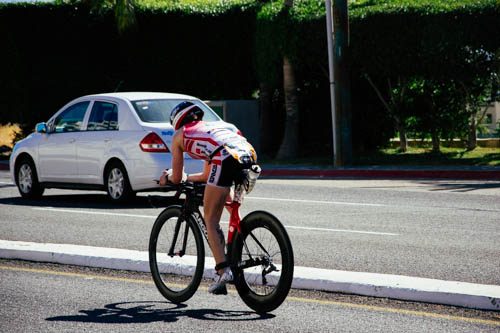
Working my way back up on my sweet Argon 18 and ENVE Composites.

Working my way back up on my sweet Argon 18 and ENVE Composites.

Coming off the bike in an Ironman is always difficult but the blazing sun made T2 in Los Cabos especially hard.  I didn’t want to leave the changing tent.  After applying a new layer of sunscreen and some serious coddling by the awesome volunteers I tore myself away.  The run was a three loop course featuring a few short hills, one dirt/sand trail, five different dog legs and lots of sunshine.  In other words… It was hard.  It was fairly uneventful; almost comically so.  Leading up to race day my teammates and I joked about the goofy things we would do as we passed each other on the run course, but when the hour was upon us, pirouettes and herkies were nowhere to be found.  We barely had the energy to give a slight nod of the head.  “Heeeey,” she said as if she were an angsty teenager who couldn’t be bothered with niceties like salutations.  “Heeeeey,” he responded, sounding equally unenthused.  So inspiring.  In the end I picked off more girls as I ticked off 26.2 miles and came across the line as the 10th Pro woman – extremely happy to be done, but secretly wanting another chance.

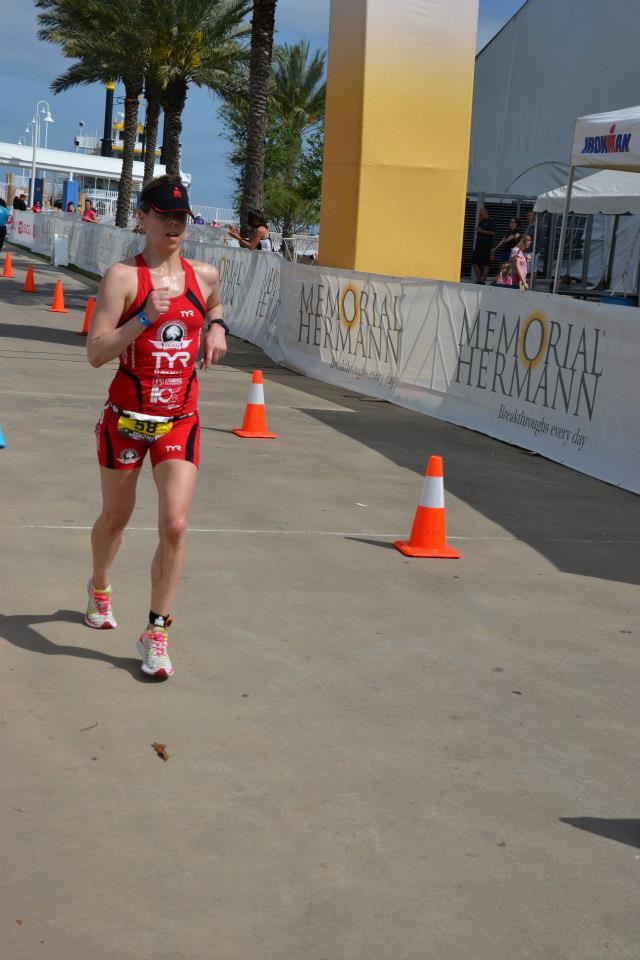
Sun, sun all around and not an inch of shade.

Monday 3/31
The day after an Ironman I am always the best kind of sore.   I am so spent that waddling hurts and the thought of stairs makes me want to cry.  As I sat there looking at the Pacific replaying the race in my mind, one thought kept forcing its way in.  I want a do-over.  It’s not whether you get knocked down, it’s whether you get up.
Posing on the stairs?  Not quite.  More like taking a break...

Posing on the stairs? Not quite. More like taking a break…

Thanks to Jeff and Matt for inspiring me on race day.  Thanks to Niki for being the ultimate travel companion, race day photographer, and “sista from another mista”.  Thanks to Debi for her wisdom, advice, and words of encouragement.  Thank you to Cyrus, Mary, and my whole family for their support and love.  And of course none of this would be possible without my incredible sponsors.  Thank you Maverick Multisport, Argon 18, ENVE Composites, VO2 Multisport, Rotor Bike Components, Occupational Kinetics, Swiftwick Socks, Cobb Cycling, TYR, Champion Systems, 110% Play Harder, Infinit Nutrition, Primal Sport Mud, Smith Optics, TriBike Transport, and Vittoria.

Lessons from Sochi*

I spent the first eighteen years of my life in Miami, Florida.  The result? I was pretty adept at running in scorching temperatures with 100% humidity.  That and… Winter sports were lost on me.  I did learn to be a fairly proficient downhill skier thanks to a very well off best friend whose father owned the biggest travel agency in South Florida, but I had no access to most winter sports.  The funny thing? For a person with a very limited history with cold weather, I have a huge affinity for the Winter Olympics.  This year I found myself watching a lot of the coverage just to see the competition play out.  Our DVR had very little available space thanks to this obsession, but I gained a few insights from all of that avid TV viewing.  Athletes regardless of their native land and regardless of their preferred sport display some amazing similarities.  The cold weather athletes in Sochi taught this fair weather triathlete a few things…

Sochi

The Importance of Control:
Marathoners, cyclists, curlers (Curlers?!), and alpine skiers all exhibit amazing amounts of control.  One of my favorite examples of control and self-awareness in sport is biathlon, an event that combines cross-country skiing and shooting.  I can’t imagine racing toward a shooting range, red-lining it on cross country skis, then stopping briefly and controlling my breathing and heart rate enough to hit a target the size of a golf ball.  The ability to race at just the right speed to quickly cover the course and still be able to shoot accurately is incredible.  Like biathletes, in triathlon we’re lucky enough to call on different skills during the same race, but a biathlete’s breathtaking sense of control inspires me to think about pacing and transitions in a whole new way.  In a race it is so easy to forget restraint, let loose, and let go, all the while risking the latter portion of the competition.  The mental focus and forethought biathletes exhibit would serve us all well.

The Importance of Resolve:
In triathlon we’re fortunate to have wave or mass starts; you and 500 of your closest friends all toe the line together.  While this might make for some scary swim conditions, it makes for great racing.  You know exactly where you stack up and where your competition is.  Many athletes at the Winter Olympics don’t have it so easy.  Long distance speed skaters race head-to-head two at a time but the real competition is most likely not the one other athlete he or she is on the track with.  The real competition could be in a heat far removed from their own.  Bobsledders have to compete ONE team at a time. They are constantly striving to have their best run because even a head-to-head match up isn’t a luxury their sport affords.  The resolve these winter athletes exhibit, always racing against the clock, is admirable and could teach us a thing or two about pushing ourselves to the limit without an audience, without competition, when no one is looking, and when no one is beside us.

The Importance of Support:
One of the best moments this year was American Noelle Pikus-Pace’s medal winning skeleton run.  When she crossed the finish and saw her blazing-fast time she literally jumped off the track and into the stands, all the while letting out yelps of joy and “We did it!  We did it!  We did it!”  Her elation was palpable.  It’s impossible to refrain from smiling when you see her reaction.  As you watch Noelle kiss her family members and soak up their love you get a sense of how important support is for every athlete.  Four years ago, Noelle placed a heart-breaking fourth place at the Olympic Games in Vancouver.  With the support of her family and friends she persevered and trained and worked tirelessly to return to this world stage.  As a triathlete it’s so hard for our family members to continuously and consistently support our hobby.  Our sacrifice usually means their sacrifice.  Having the support of those around you can change EVERYTHING.  (Just ask the three Russian men who rallied in the final meters of the men’s 50k cross country race with the help of the home crowd to sweep the podium in Sochi.) It’s important to nurture the relationships we have with our loved ones to keep that support structure strong and resilient.

The twenty-second Winter Olympiad was full of harrowing stories and important lessons.  I suspect wherever two or more athletes are gathered comradereie, competition, and learning experiences are created.  If you’re in the market for more life lessons and a healthy dose of inspiration, the Paralympics start March 7th.

Small Fish

In his new book, David and Goliath, Malcolm Gladwell theorizes that sometimes conditions traditionally perceived as disadvantageous can actually be advantageous.  At first glance a fight between David and Goliath is a no-brainer.  Goliath is a giant who can crush the tiny shepherd with nary a thought, right?  Maybe not.   We initially fail to consider David’s speed, agility, and resourcefulness.  The small shepherd used the disparity in size to his advantage – to fight Goliath on his own terms, not the giant’s.  The book goes on to ponder the good that can come out of other less than desirable circumstances like large class size, dyslexia, being the underdog going into a game, and even losing a parent.  All of Gladwell’s chapters present fascinating data in a new light, but one chapter in particular stayed with me.  In this chapter, Gladwell tells the story of a woman, who while growing up, wanted a career in the sciences.  Through grade school, middle school, and high school she excelled in math and science, but when college rolled around something interesting happened.  She floundered.  She registered, attended, and studied for college-level science courses and she could not hold her own.  After a few semesters she completely changed her track, dropped the science classes, and ultimately majored and obtained a degree in a completely different field.  Why the change?  This woman who wanted to be a scientist for as long as she can remember, who admittedly still dreams of what could have been had she stayed the course, succeeded in the field she loves until she got to college and then everything fell apart.  The reason for the change, Gladwell theorizes, is this woman’s choice of college.  Instead of choosing a large state school, she chose to attend an Ivy League university.  And with that choice she went from being a very big (successful) fish in a small pond, to a very small fish in a very big pond.  Was she still smart and driven?  Sure, but no more so than everyone else around her.  She didn’t stand out at Brown or have the feelings of success or accomplishment that she would have enjoyed had she attended a school with a less prestigious student body.  When she looked around her organic chemistry class she felt inferior for the first time in her life.  Would she be a scientist today if she went to the University of Maryland instead of Brown?  Probably.  In her case, attending an Ivy League school, something almost all of us think of as being an advantage, turned out to be a disadvantage.

This season, I, like the woman Gladwell introduced to us, went from being a big fish in a small pond to being a small fish in a very very big pond.  This change was not lost on me.  Going into the 2013 season I was quite worried that I wouldn’t be able to handle the stress or the expectations of racing as an elite athlete.  My first race as a professional triathlete, the women’s pro field included Leanda Cave, Mirinda Carfrae, ITU superstars, and past Ironman champions.  Not only was I worried about my race, I was worried about my performance compared to these women’s performances.  I was worried about my swim, my bike, my run, and my ego.  Going into 2013, I thought it would be fun to race as a professional for a year – experience the perks, rub shoulders with the big dogs, check the box, and move on with life.  Not surprisingly I found myself toward the middle or bottom of many race results.  Surprisingly, even though my ego took a hit, my spirit wasn’t dampened.  Unlike the woman in Gladwell’s book, as the season went on, I became more emboldened, more motivated.  I might have been a small fish, but I was a small fish with big dreams.  After competing in nine half ironman distance races and qualifying for Worlds 70.3, I decided to add one more race to the 2013 calendar – Ironman Florida.  The last time I did an Ironman I was burnt literally and figuratively.  Soon after the race I told my coach that the full distance wasn’t for me and I would never toe the line at one of these races again.  But racing my heart out this season as a small fish changed something. I wasn’t going to let anything intimidate me – not a pro start list, not a hurtful comment, not one bad race, and certainly not a race distance.  The result?  A huge PR.  In Florida I covered 140.6 miles in nine hours and thirty-eight minutes.  (I am happy with the time but never ever satisfied.)

Changing ponds can be pretty amazing… And this small fish?  She’s gettin’ bigger.

My good side... Bringing it home.

My good side…
Bringing it home in Panama City.

Panic and Pacing

There is a scene in Blackfish, a documentary about the effects of captivity on killer whales, that will stay with you long after the credits have stopped rolling. In it Kenneth Peters, a trainer at Sea World San Diego jumps into one of the marine park’s huge tanks to perform the finale of one of the day’s Shamu shows with Kasatka, a twenty-something female killer whale. As soon as Peters jumps into the water, the killer whale grabs the trainer by the foot and drags him down to the bottom of the deep tank. Luckily, the narrator of Blackfish notes, not only does Peters have experience with animals, he is also an accomplished diver. When the killer whale brings the trainer back to the surface, Peters doesn’t scream or panic or flail about. He simply pats the killer whale as if to say, “It’s okay” and he starts breathing very methodically in an effort to pack his lungs with more air in the likely event that he would be dragged down again. Sure enough, a few moments later Kasatka takes him back down to the bottom of the tank and holds him there for what seems like an eternity. The whale finally pulls Peters back up and the trainer shows the same forethought that he did before, even though the situation is becoming more dire. Over the course of the next few minutes the killer whale continues her routine of burying and resurfacing. She eventually lets the trainer go only to grab his other foot and continue the dangerous cycle. Toward the end of the clip, the trainer’s expression becomes more and more desperate; the audience can tell simply by looking at his face that Peters knows he is going to die. Thankfully after almost fifteen minutes, Peters was able to escape with the help of a momentary lapse of focus on the whale’s part, a large net, and his incredibly fast swimming (given the little air and two broken feet he was working with). The most incredible part of this story, aside from the fact that Peters survived, is the forethought and sense of calm the trainer had throughout the entire incident. That of course got me thinking about triathlon… (Thankfully training and racing are nowhere near as dangerous as Peters’ ordeal.)

During a race we all have those little moments of panic when we wonder if we paced ourselves correctly. Did I go too hard on the first part of the bike? Did I burn too many matches on that hill? What if I get off the bike and I can’t run? I hope my legs can carry me through the back half of this marathon. In triathlon the opportunities for over-pacing, impatience, and self-doubt are endless. With a background in endurance sports I think I’ve always known this, but my last two triathlons made this fact abundantly clear. This year SavageMan 70.0, undoubtedly one of the most difficult triathlons around, was held on September 15th, one week after the Ironman 70.3 World Championship in Las Vegas. I decided to do both. The uncertainty leading up to my second long distance triathlon in eight days was unlike anything I had experienced before. Several days after Worlds, my body was still feeling the effects of the race. Luckily toward the end of the week my bike and run legs had returned just in time to drive to Deep Creek Lake, Maryland for SavageMan. I knew that if I wanted to do well, I had to follow my pace and nutrition plans to the letter. During a race when things are moving so fast I find it easy to get wrapped up in what’s going on around me. My swim was so slow, maybe I’ll push it a little harder on the bike. I can’t let her pass me… I hate these road conditions. Getting caught in the moment like that could cause me to sacrifice the latter stages of the race because I’ve let panic, lack of focus and self-doubt seduce me away from my plan. “Bike for show; run for dough.” “Bike how you should, not how you could.” These sayings are everywhere but the truth in them is undeniable. Without forethought and proper pacing early on, an entire race could be sacrificed. During SavageMan I had a lot (and I mean a lot) of time to think about this on the bike. Cyclists who were having faster, better, more powerful days than me rode past, one after another (after another). I wanted to follow, but pursuing them at their pace wasn’t an option. I had to hold back, race within myself and trust in my training. Like Peters who relied on his experience with diving and animals to stay composed, endurance athletes must rely on their pace and nutrition plans to execute their races correctly. A little focus and forethought go a long (long) way.

There’s only one finish line and it’s at the finish. Happy training!

Finishing the run at SavageMan.  First pro and fastest run of the day.

Finishing the run at SavageMan 70.0.  First female pro and fastest run split of the day.

People Who Need People

One of my favorite things to do besides training and racing is watching others train and race.  I can spend hours in front of the TV watching Jonathan Brownlee dominate a race.  (Okay less than two hours in that particular case.)  Or spend the better part of a Sunday refreshing Ironmanlive.com for the latest updates and blog posts about that weekend’s races.  Last weekend was no different.  Between my own bike and run workouts of the day I snuck in a fair amount of time on the internet stalking the competitors of Timberman 70.3 and Ironman Mont-Tremblant.  It was on the website featuring the latter, that a little less than ten hours after the start, a picture was posted on the live blog.  The picture was taken in the finishline area and as such there are a lot of people milling around, but the main subjects are clearly Jesse Kropelnicki, the head coach of QT2, and Jennie Hansen, a QT2 athlete who had just come in sixth, with the second fastest marathon split of the day (only three short weeks after her win in Lake Placid).  The picture itself is breathtaking.  Aside from pure joy, you can feel Jennie’s exhaustion and Jesse’s utter elation.  I’ve never seen anything like it and I think it captures something truly amazing about our sport.
.
Every pre-race athlete meeting you go to features a head official reviewing the rules regarding clothing requirements, warning people about the consequences of littering, and going into great detail about what constitutes drafting and the penalties for doing so.  “Triathlon is an individual sport,” they always say.  Only on race day…  Only on race day.  Behind every triathlete is a significant other, a coach, a training partner, family, friends, and teammates who make triathlon possible for that athlete.  Without these people devotion wouldn’t be feasible, excellence wouldn’t be achievable, and training wouldn’t be enjoyable.  The picture of Jesse and Jennie inspired me to think about all of the people without whom I couldn’t do this wonderful thing that I love to do.
.
At the end of last season, when I decided to get my elite card I came up with a crazy goal of making it back to the Ironman 70.3 World Championship as a pro.  Qualifying as an age-grouper is hard.  What I didn’t fully comprehend was how difficult it would be to get back to Vegas as a professional.  But, here I am months and months later and I have qualified for the World Championship as a first year pro.  I am over the moon, but more importantly thankful.  I wouldn’t be going to Vegas without the amazing people in my life.  Thank you for everything…
.
Thanks for supporting me when I took a leave of absence from teaching.
Thanks for flying to my races in San Juan and Vegas even though you HATE to fly.
Thanks for tracking me from afar and analyzing my results.
Thanks for wiping away my tears.
Thanks for always picking the best triathlon houses.
Thanks for coming to the hospital.
Thanks for listening to me complain.
Thanks for making me smile.
Thanks for helping me make tough decisions.
Thanks for letting me stay at your mom’s house for my first homestay.
Thanks for eating what I want to eat the night before the race.
Thanks for driving the course with me.
Thanks for extending your workout even though you didn’t have to.
Thanks for making amazing playlists.
Thanks for getting up really really early.
Thanks for pretending my pre-race OCD is normal.
Thanks for getting really bad bad songs stuck in my head.
Thanks for racing me to see who can get the lowest heart rate.
Thanks for looking over my transition area.
Thanks for taking really bad pictures.  (The subject is flawed not the cameraman.)
Thanks for drafting my nutrition plan.
Thanks for listening to my really bad jokes and super long stories.
Thanks for telling me to go to bed early.
Thanks for reminding me about life outside of triathlon.
Thanks for giving me a FB shout out.
Thanks for writing letters on my behalf.
Thanks for being my sounding board.
.
Thanks for the hugs, the kisses, the well-wishes, the high-fives, the spanks, the advice, the workouts, the sympathy, the empathy, the songs, the texts, the calls, the pancakes, the bike, the company, the drills, the critiques, the encouragement, the time, the prayers, the support, and the love.

image

Abracadabra

I recently discovered a show on the National Geographic Channel called “Brain Games”.  In one particular episode the producers challenge the audience to be a good witness to a crime.  That is – witness a crime in progress and then try to recall as many pertinent details as you can accurately.  The TV audience gets to play along with individuals who were present for the staged crime, a pickpocket incident.  It was disturbing to see how easily details were forgotten and supplanted with new ones, how conflicting the eyewitness accounts were, and how many people grossly misremembered what actually happened.  The narrator explains this phenomenon by discussing our active memory and its limitations.  Our active memory is designed to hold a few pieces of information (like what you wanted from the refrigerator when you got off the couch or where you put your car keys) for a very short time.   Problems arise when you try to recall many minute details, like what a suspect was wearing or the names of each person in a new group, long after seeing the person or meeting those individuals.

As it happens those tasks are not difficult at all for Ron White, a two time USA Memory Champion.  During the course of the show we see White memorize the serial numbers of four one dollar bills in one pass, remember the names of twenty strangers walking into a theater, and accurately recall the order of an entire deck of cards after scanning the deck only once.  To outsiders these tasks seem incredible, née almost impossible.  So how does he do it?  With strategy and lots and lots of practice.  Remembering the serial numbers on a bill?  Ron will chunk that string of numbers into smaller two digit numbers that each correspond to a predetermined picture in Ron’s head.  “94” would have its own distinct image, just like “12”, “78” and “49”.  He then “places” those pictures in a memory map of his house.  As he “walks though” his house in his minds eye he sees the figures sitting on pieces of furniture and he can recall the corresponding numbers in order.  Remembering the names of twenty strangers?  Easy… (with practice).  He assigns common names a picture.  “Gary” might be a garage; “Chris” might be Santa Claus.  Once he sees the person he takes that picture and combines it with some feature on the person that stands out.  If Gary has a big nose, White might picture a garage falling on Gary’s nose.   When the veil is pulled back and we get a glimpse into Ron White’s process, the incredible things he does seem a little more achievable.  Not easy by any stretch of the imagination, but certainly not magic and something we mere mortals could replicate on some small scale with some time and focus.

During this episode of “Brain Games” Ron White likened himself to a mental athlete.  He practices every day just like Lebron James or Missy Franklin.  The only difference?  His is a sport of the mind.  As cool as it was to see him pull off theses amazing feats, my favorite thing that he said?  “With a little practice, anyone can do it.”

When I tell people outside of the running and triathlon worlds what I do with regards to training and racing I usually get two responses in the following order… One: A look of wonder and awe sweeps over the individual’s face.  This look is quickly followed up with response number two: a phrase that sounds something like “Wow!  I could never EVER do that.”  I’m not quite sure what to say when I hear this, but over the past year or two my retort has been very similar to White’s: “Sure you can.  It just takes some training.”  There is no magic involved in endurance sports.  If you want to succeed, you have to endure.  If you want to endure, you have to practice enduring.  A lot.  And consistency is everything.  Swimming, cycling, running, recovering, stretching, and eating right are not optional.  You have to practice every day – no skipped workouts or excuses allowed.  If you can do that… Voila!  Sweet sweet success.

Two flats, two feet, and a little heart…

“Not again.”  That was my first thought. “This cannot be happening to me again.”  I had ridden to mile 40 in Ironman Texas 70.3 and I had flatted in a race. Again.

The race up until that point had been blissfully uneventful.  I managed to stay with the back pack during the 1.2 mile swim, rip off my wetsuit, and grab my new Cervelo P5 for what I hoped would be a powerful, yet vanilla, ride.  On the way out I managed to reel in two pros and after the turnaround I had a renewed sense of purpose when I saw how within reach some of the other girls were.  My nutrition was dialed in and everything was going according to plan.  That is, of course, until my front wheel met that rock around mile 40.  As soon as I hit it I knew.  I knew I had a flat.  I knew I had to stop.  I knew I was going to lose time. And I knew I could only rely on myself to fix it. (In the athlete briefings leading up to race day the officials always talk about support on the course.  From what I have experienced there is never tech support when you need it.  Never. Ever.) So I pulled out my can of Pit Stop, a sort of on-the-go sealant that oftentimes relieves a very anxious and harried cyclist from having to change a flat.  But when I started to use the Pit Stop by pressing the rubber end onto the valve of my flat tire, I quickly realized this job was a little too big for such an easy remedy.  For when I pressed that rubber end onto the valve, the white foamy sealant went into the tube and then immediately back out of the hole created by the blowout and then, quite hazardously into my face.  Luckily for me, when getting my bike race ready in addition to the Pit Stop I opted to also carry a spare tube.  So what’s a girl to do when plan A doesn’t work?  She has to put on her big girl panties and change the damn tire.  So that’s what I did.  About ten minutes after my date with the rock, I was off and rolling again. Of course while I was doing all of this, the pros that I had managed to reel in had cut the line and raced ahead.

16 miles.  16 short miles. That’s all that stood between me and T2 – where I would find my socks, my shoes, a visor, and the final leg of the race where mechanical issues couldn’t bring me down.  Anyone can ride 16 miles right?

About a mile and a half out from T2 I rode down what can only be described as the ugliest patchwork of asphalt ever called a street.  My heart skipped a beat with every jolt, every bump, and every dip.  The sidewall of my tire was compromised from hitting the rock earlier and if a pothole so much as looked at my front wheel cross eyed I was doomed.  Somehow I managed to make it down said street.  But just as I approached the airport tarmac that made up the last mile of the course, a strip of dirt and rocks appeared where the asphalt had been completely torn away.  I rode over it and… Sssssssss.  Flat. Number. Two.  Only this time?  Not only did I not have race “support”, I didn’t have Pit Stop, and I didn’t have another spare tube.

One mile.  One long mile.  That’s all that stood between me and T2 – where I could finally rack this hobbled machine and get on with the race.  Anyone can run a mile right?

I took off my bike shoes and put them in my left hand (because no one wants to start a half marathon with bloody heels) and I grabbed the saddle of my bike with my right hand and I ran… barefoot, across the tarmac.  Oh and that one pro I had managed to reel in again after flat number one?  She passed me.  Again.  When I finally made it back into transition I was so happy to be there all thoughts of DNFing disappeared.  I had made it this far, what was 13.1 more miles?  All things considered, I managed to turn in a pretty good run split as I tracked down and stalked the girl that passed me during my two flat debacles.  In the end, the final pass of the day would be mine.

While this certainly wasn’t the race I had hoped for, I certainly hope to have this much heart in every race.  Next up?  St.Croix 70.3.  I can’t wait!

Two bare feet… And sweet sweet shoes!

photo (6)

67502_622253707788945_1729527657_n

Second Verse Better Than the First

DNF.  Those three little letters strike fear in the hearts of endurance athletes everywhere.  Months and months of training, planning, and organizing culminate in one race and the letters DNF will ruin the whole thing.  On Sunday, I DNFed my first pro race.  Just before the halfway point, after going through a particularly bumpy patchwork of asphalt, my back wheel felt “off.”  I was hoping it was just the gnarly road conditions throwing me for a loop. But, alas, when I pulled over, the disc wheel I was riding was completely flat.  As I started the process of changing it, I hoped that a sag vehicle with a savvy bike tech guy would pull up and fix the flat in no time.  No such luck.  I didn’t break any speed records while changing the flat, but I was able to replace the tube without incident and get back on a working bike.  Unfortunately soon after I pulled over, the four or five pro females that I had been leading zoomed past and more and more age groupers emptied onto what was now a very crowded loop course.  After passing the halfway point, I knew I had a tough decision to make.  Should I continue the race and try to claw my way back into a very deep field of professional athletes for only a few points or should I consider pulling out of the race, avoiding the very challenging run course in order to save my legs to race again another day soon?

As I weighed my options I kept coming back to something my coach told me on a ride soon after we started working together.  We were talking about her experience as a runner and her strategy going into a marathon.  She said that before she starts a marathon she studies the course and plans an escape route.  That is, if things are not going well, she has a place on the course where she can pull out and easily get back to her support crew.  Her logic?  Why compromise your whole season for one race?  When she told me this I honestly thought, “This lady is a crazy person.”  Pull out of a race?!  Pull out of a race voluntarily?!?!?!? No. Way.  Fast forward a couple of years and that is exactly what I did.  I finished the bike leg of the race (because why shouldn’t I get in some sort of workout) and after I got out of T2 I handed my chip over to an official. D. N. F.  My first 70.3 as a professional athlete turned out to be a very real dress rehearsal. And though I am disappointed with the way it played out I learned a lot and I know I made the right decision when I look at the bigger picture.  DNF…  “Did not finish”?  Or “Definitely not finished”?  I choose than latter.  Bring it on.

‘Twas the Night Before…

You know what they say about sleep before a big race?  It’s not the night before that matters.  (For surely that sleep will be fitful and interrupted and stunted by nerves just tingling at the surface waiting to mar your precious rest.)  They say it’s the night before, the night before the big race that matters.  You still have a little buffer before the big event and sweet sweet sleep bestows her graces upon you one more time before releasing you to pre-race jitters.  A few nights ago I experienced the uncomfortable uneasy feeling that I usually only get the night before a big race.  The problem?  I was more than two weeks away from race day.  (TWO weeks!). Why so antsy you say?  Instead of giving into the rest and recovery that lie ahead, I was focusing on “what if”s.  What if Leanda Cave, Mirinda Carfrae, Kelly Wlliamson, Jodie Swallow, and Caitlin Snow all show up at San Juan 70.3 (as they are scheduled to)? What if I have a bad swim?  What if I get lost on the bike course?  What if? What if? What if?  I was so worried about how I was going to perform, I could not fall asleep.

I recently read a great article by QT2 Systems head coach, Jesse Kropelnicki.  In it he describes where athletes typically put their focus and where athletes should put their focus.  According to Jesse in the focus hierarchy, goals should come first, targets second, and outcomes should come third (and last).  Oftentimes we reverse the order of things and become obsessed with the outcome or end result without mastering the first two items on the list.  The problem with that? Outcomes can be largely out of our control, especially if you haven’t worked on achieving your goals (like learning how to pace or developing mental toughness) or worked on hitting your targets (like achieving a certain swim or run pace).  If you work on your goals and targets first your desired outcome is more likely to fall into place.  Obsessing over how we are going to place or if we are going to podium is just wasting energy that could be channelled elsewhere.  If you focus on the process, not the end result, everything changes.  EVERYTHING.  I am so happy that I was reminded of this going into the 2013 season.  Bring on the journey!